Forms of cruelty:-
Neglect-
There are many reasons why individuals abuse animals. Animal cruelty covers a wide range of actions (or lack of action). Learning about animal abuse has revealed patterns of behavior employed by abusers.
Animal cruelty is often broken down into two main categories: active and passive, also referred to as commission and omission, respectively.
Passive cruelty is typified by cases of neglect, in which the cruelty is a lack of action rather than the action itself. Examples of neglect are starvation, dehydration, parasite infestations, allowing a collar to grow into an animal’s skin, inadequate shelter in extreme weather conditions, and failure to seek veterinary care when necessary. In many cases of neglect in which an investigator believes that the cruelty occurred out of ignorance, the investigator may attempt to educate the pet owner, then revisit the situation. In more severe cases, exigent circumstances may require that the animal be removed for veterinary care.
Industrial animal farming-
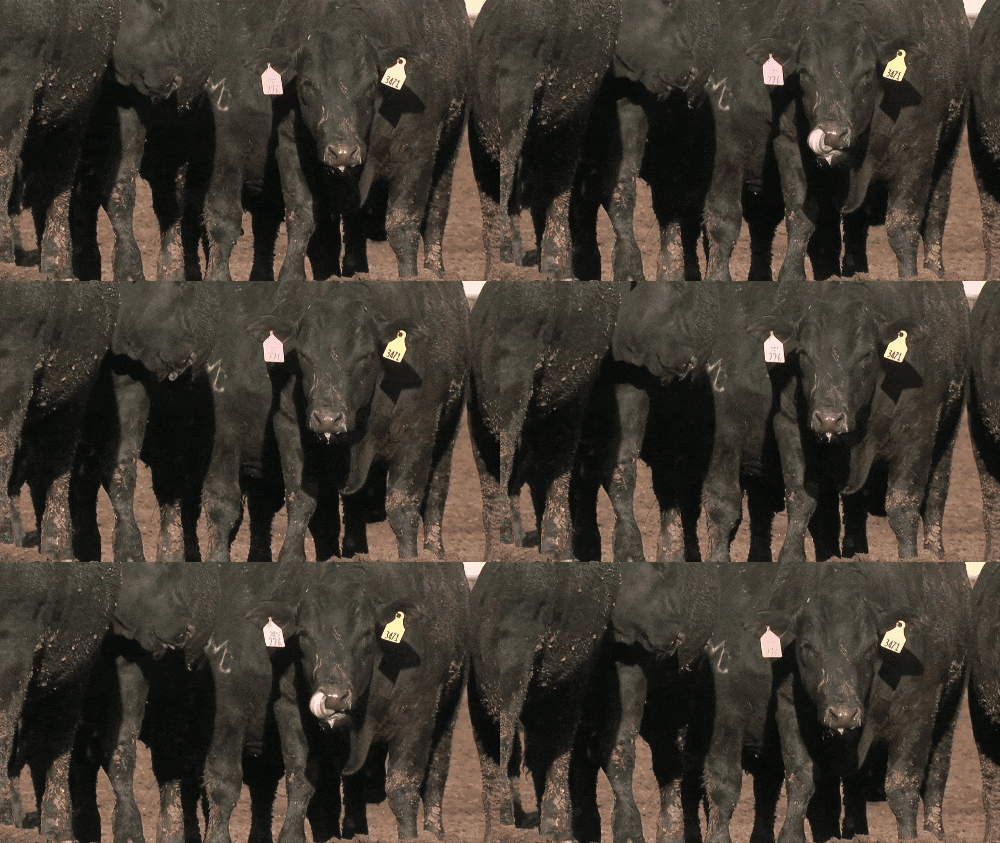
Farm animals are generally produced in large, industrial facilities that house thousands of animals at high densities; these are sometimes called factory farms. The industrial nature of these facilties means that many routine procedures or animal husbandry practices impinge on the welfare of the animals and could arguably be considered as "cruelty". It has been suggested the number of animals hunted, kept as companions, used in laboratories, reared for the fur industry, raced, and used in zoos and circuses, is insignificant compared to farm animals, and therefore the "animal welfare issue" is numerically reducible to the "farm animal welfare issue". Similarly, it has been suggested by campaign groups that chickens, cows, pigs, and other farm animals are among the most numerous animals subjected to cruelty. For example, because male chickens do not lay eggs, newly hatched males are culled using macerators or grinders. The American Veterinary Medical Association accepts maceration subject to certain conditions, but recommends alternative methods of culling as more humane. Egg-laying hens are then transferred to "battery cages" where they are kept in high densities. Matheny and Leahy attribute osteoporosis in hens to this caging method. Broiler chicken suffer similar situations, in which they are fed steroids to grow at a super-fast speed, so fast that their bones, heart and lungs often cannot keep up. Broiler chickens under six weeks old suffer painful crippling due to fast growth rates, whilst one in a hundred of these very young birds dies of heart failure.
To reduce aggression in overcrowded conditions, shortly after birth piglets are castrated, their tails are amputated, and their teeth clipped. Calves are sometimes raised in "veal crates", which are small stalls that basically immobilize calf during their growth, reducing costs and preventing muscle development, making the resulting meat a pale color, preferred by consumers.
Animal cruelty such as soring, which is legally restricted, sometimes occurs on farms and ranches, as does lawful but cruel treatment such as livestock branding. Since Ag-gag laws prohibit video or photographic documentation of farm activities, these practices have been documented by secret photography taken by whistleblowers or undercover operatives from such organizations as Mercy for Animals and the Humane Society of the United States posing as employees. Agricultural organizations such as the American Farm Bureau Federation have successfully advocated for laws that tightly restrict secret photography or concealing information from farm employers.
The following are lists of invasive procedures which cause pain, routinely performed on farm animals, and housing conditions that routinely cause animal welfare concerns. It is arguable whether these practices are cruelty to animals.
Psychological disorders-
Active cruelty, on the other hand, is intentional; an example of such an act is flushing a live aquarium fish down a toilet.Acts of intentional animal cruelty (sometimes referred to as "non-accidental injury") may be indicators of serious psychological problems. According to the American Humane Association, 13% of intentional animal abuse cases involve domestic violence. As many as 71% of pet-owning women seeking shelter at safe houses have reported that their partner had threatened and/or actually hurt or killed one or more of their pets; 32% of these women reported that one or more of their children had also hurt or killed pets. Battered women report that they are prevented from leaving their abusers because they fear what will happen to the animals in their absence. Animal abuse sometimes is used as a form ofintimidation in domestic disputes.
One of the known warning signs of certain psychopathologies, including antisocial personality disorder, also known as psychopathic personality disorder, is a history of torturing pets and small animals, a behavior known as zoosadism. According to the New York Times, "[t]he FBI has found that a history of cruelty to animals is one of the traits that regularly appears in its computer records of serial rapists and murderers, and the standard diagnostic and treatment manual for psychiatric and emotional disorders lists cruelty to animals a diagnostic criterion for conduct disorders. "A survey of psychiatric patients who had repeatedly tortured dogs and cats found all of them had high levels of aggression toward people as well, including one patient who had murdered a young boy." Robert K. Ressler, an agent with the Federal Bureau of Investigation's behavioral sciences unit, studied serial killers and noted,"Murderers like this (Jeffrey Dahmer) very often start out by killing and torturing animals as kids."
Cruelty to animals is one of the three components of the Macdonald triad, indicators of violent antisocial behavior in children and adolescents. According to the studies used to form this model, cruelty to animals is a common (but not universal) behavior in children and adolescents who grow up to become serial killers and other violent criminals.
It has also been found that children who are cruel to animals have often witnessed or been victims of abuse themselves.In two separate studies cited by the Humane Society of the United States roughly one-third of families suffering from domestic abuse indicated that at least one child had hurt or killed a pet.
Cultural rituals-
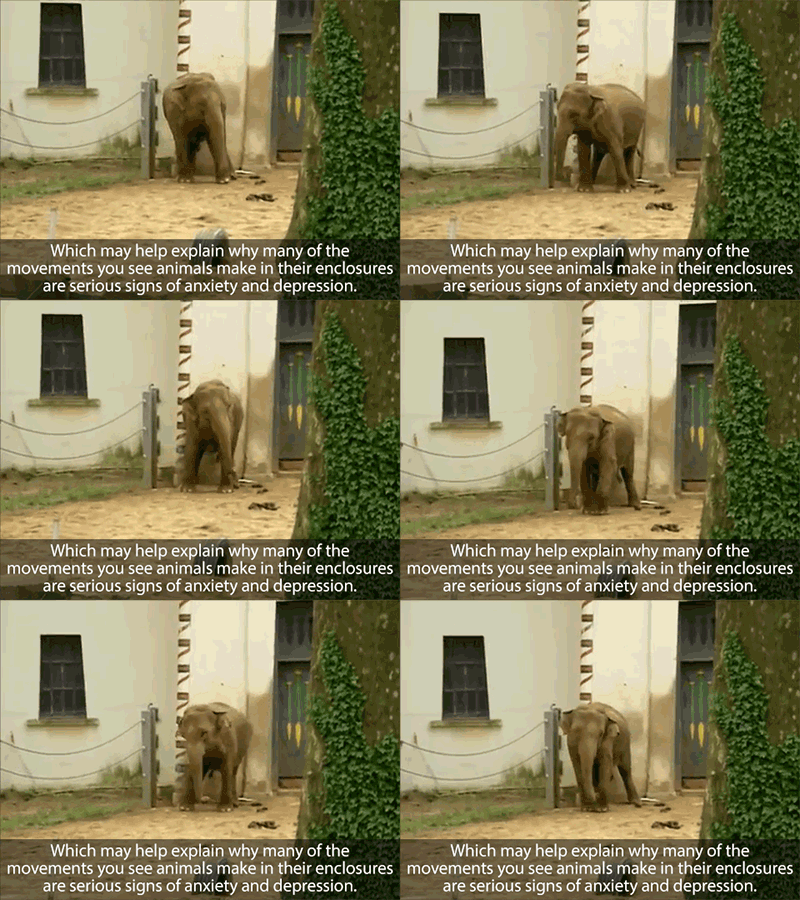
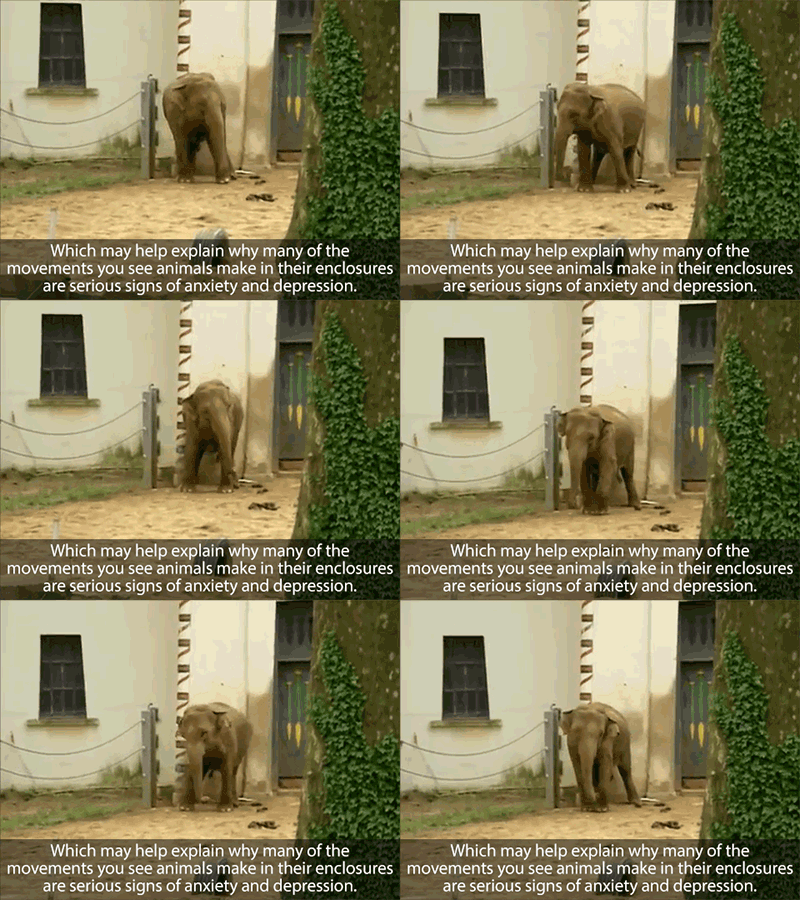
Many times, when Asiatic elephants are captured in Thailand, handlers use a technique known as the training crush, in which "handlers use sleep-deprivation, hunger, and thirst to 'break' the elephants' spirit and make them submissive to their owners"; moreover, handlers drive nails into the elephants' ears and feet.
The practice of cruelty to animals for divination purposes is found in ancient cultures, and some modern religions such asSanteria continue to do animal sacrifices for healing and other rituals. Taghairm was performed by ancient Scots to summon devils.
Animal cruelty has long been an issue with the art form of filmmaking, with even some big-budget Hollywood films receiving criticism for allegedly harmful—and sometimes lethal—treatment of animals during production. One of the most infamous examples of animal cruelty in film was Michael Cimino's legendary flop Heaven's Gate, in which numerous animals were brutalized and even killed during production. Cimino allegedly killed chickens and bled horses from the neck to gather samples of their blood to smear on actors for Heaven's Gate, and also allegedly had a horse blown up with dynamite while shooting a battle sequence, the shot of which made it into the film. After the release of the film Reds, the star and director of the picture, Warren Beatty apologized for his Spanish film crew's use of tripwires on horses while filming a battle scene, when Beatty wasn't present. Tripwires were used against horses when Rambo III and The Thirteenth Warrior were being filmed. An ox was sliced nearly in half during production of Apocalypse Now, while a donkey was bled to death for dramatic effect for the film Manderlay, in a scene later cut from the film.
There is a case of cruelty to animals in the South Korean film The Isle, according to its director Kim Ki-Duk. In the film, a real frog is skinned alive while fish are mutilated. Seven animals were killed for the camera in the controversial Italian filmCannibal Holocaust. The images in the film include the slow and graphic beheading and ripping apart of a turtle, amonkey being beheaded and its brains being consumed by natives and a spider being chopped apart. In fact, Cannibal Holocaust was only one film in a collective of similarly themed movies (cannibal films) that featured unstaged animal cruelty. Their influences were rooted in the films of Mondo filmmakers, which sometimes contained similar content. In several countries, such as the UK, Cannibal Holocaust was only allowed for release with most of the animal cruelty edited out.
More recently, the video sharing site YouTube has been criticized for hosting thousands of videos of real life animal cruelty, especially the feeding of one animal to another for the purposes of entertainment and spectacle. Although some of these videos have been flagged as inappropriate by users, YouTube has generally declined to remove them, unlike videos which include copyright infringement.
The Screen Actors Guild (SAG) has contracted with the American Humane Association (AHA) for monitoring of animal use during filming or while on the set. Compliance with this arrangement is voluntary and only applies to films made in the United States. Films monitored by the American Humane Association may bear one of their end-credit messages. Many productions, including those made in the US, do not advise AHA or SAG of animal use in films, so there is no oversight.
Simulations of animal cruelty exist on television, too. On the September 23, 1999 edition of WWE Smackdown!, a plot line had professional wrestler Big Boss Man trick fellow wrestler Al Snow into appearing to eat his pet chihuahua Pepper.

Circuses-
The use of animals in the circus has been controversial since animal welfare groups have documented instances of animal cruelty during the training of performing animals. The Humane Society of the United States has documented multiple cases of abuse and neglect, and cites several reasons for opposing the use of animals in circuses, including confining enclosures, lack of regular veterinary care, abusive training methods and lack of oversight by regulating bodies. Animal trainers have argued that some criticism is not based in fact, including beliefs that animals are 'hurt' by being shouted at, that caging is cruel and common, and the harm caused by the use of whips, chains or training implements.
In 2009, Bolivia passed legislation banning the use of any animals, wild or domestic, in circuses. The law states that circuses "constitute an act of cruelty." Circus operators had one year from the bill's passage on July 1, 2009 to comply.
In 2010, Lebanese animal rights groups became enraged when it was learned that wild performing animals belonging to the Monte Carlo Circus were transported from Egypt to Lebanon without being provided with food and water.
Following the campaign, new regulations were enacted that prohibit the use of animals in circuses in Israel. Finland andSingapore have restricted the use of animals in entertainment. The UK and Scottish Parliaments have committed to ban certain wild animals in travelling circuses and approximately 200 local authorities in the UK have banned all animal acts on council land. Animal acts are still very popular throughout much of Europe, the Americas and Asia. In the United States animal welfare standards are overseen by the United States Department of Agriculture under provisions of the Animal Welfare Act. Efforts to ban circus animals in cities like Denver, Colorado have been rejected by voters. Some circuses now present animal-free acts.
Bullfighting & Crush Films-
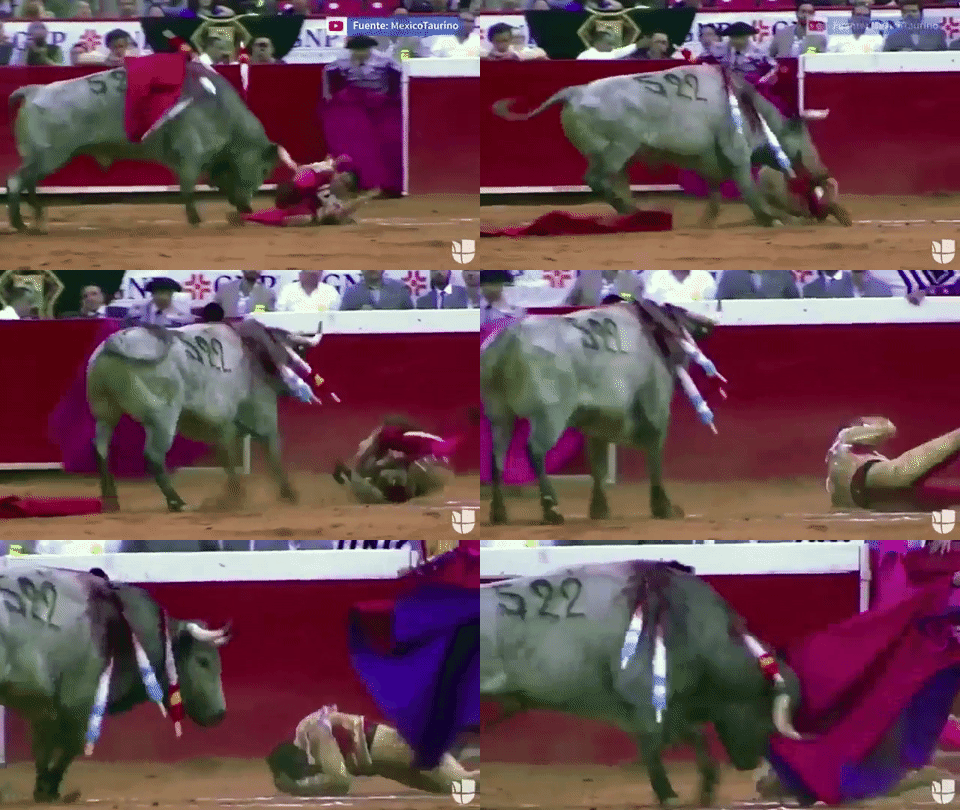
Bullfighting is criticized by animal rights or animal welfare activists, referring to it as a cruel or barbaric blood sport in which the bull suffers severe stress and a slow, torturous death. A number of activist groups undertake anti-bullfighting actions in Spain and other countries. In Spanish, opposition to bullfighting is referred to as antitaurismo.
The Bulletpoint Bullfight warns that bullfighting is "not for the squeamish", advising spectators to "be prepared for blood". It details prolonged and profuse bleeding caused by horse-mounted lancers, the charging by the bull of a blindfolded, armored horse who is "sometimes doped up, and unaware of the proximity of the bull", the placing of barbed darts by banderilleros, followed by the matador's fatal sword thrust. It stresses that these procedures are a normal part of bullfighting and that death is rarely instantaneous. It further warns those attending bullfights to "be prepared to witness various failed attempts at killing the animal before it lies down."
Animal snuff films, known as crush films can be found on the Internet. These films depict instances of animal cruelty, and/or pornographic acts with animals, usually involving the death of an animal, including insects, mice, rats, guinea pigs, hamsters, monkeys, birds, cats, and dogs. In 1999, the U.S. government banned the depiction of animal cruelty; however, the law was overturned by the 3rd U.S. Circuit Court of Appeals which ruled that the category "depiction of animal cruelty" contained in the law was not an exception to First Amendment protections. In an 8–1 decision handed down in April 2010, the U.S. Supreme Court agreed with the lower court's ruling, but on the grounds that the law was unconstitutionally broad. The case itself did not involve crush films, but rather, a video that in part depicted dogfighting.
Warfare-
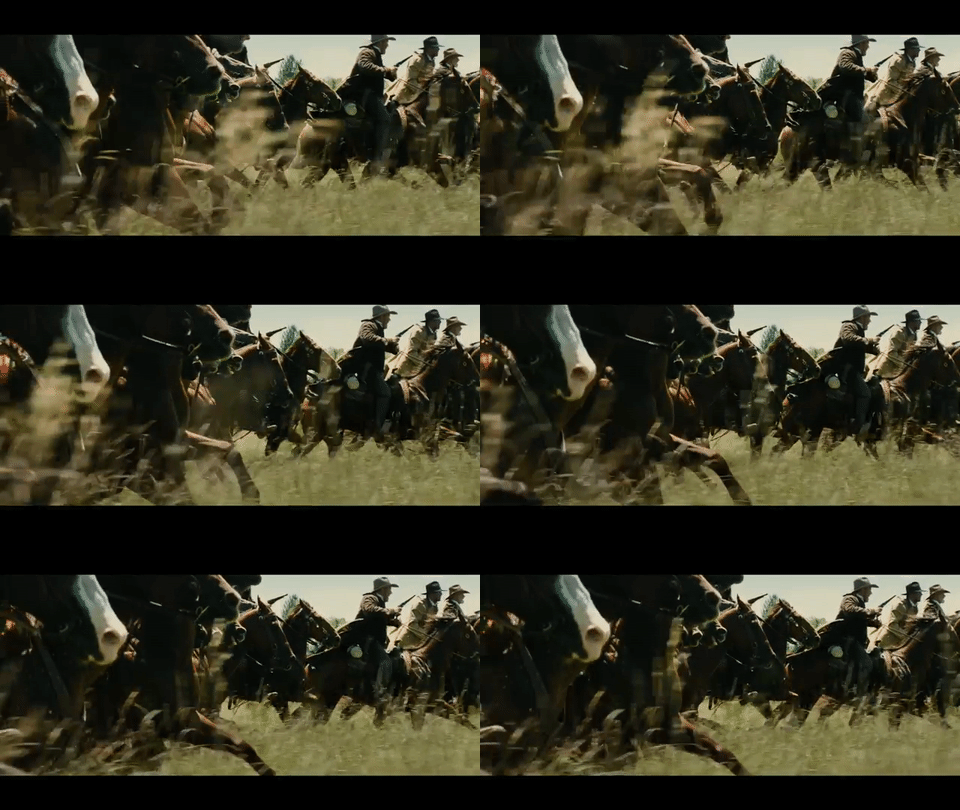
Military animals are creatures that have been employed by humankind for use inwarfare. They are a specific application of working animals. Examples includehorses, dogs and dolphins. Only recently has the involvement of animals in war been questioned, and practices such as using animals for fighting, as living bombs (as in the use of exploding donkeys) or for military testing purposes (such as during the Bikini atomic experiments) may now be criticised for being cruel. Princess Anne, the Princess Royal, the patron of the British Animals in War Memorial, stated that animals adapt to what humans want them to do, but that they will not do things that they don't want to, despite training. Animal participation in human conflict was commemorated in the United Kingdom in 2004 with the erection of the Animals in War Memorial in Hyde Park, London.
In 2008 a video of a US Marine throwing a puppy over a cliff during the Iraq conflict was popularised as an internet phenomenon and attracted widespread criticism of the soldier's actions for being an act of cruelty.
Under all three of the conceptual approaches to animal cruelty discussed above, performing unnecessary experiments or demonstrations upon animals that cause them substantial pain or distress may be viewed as cruelty. Due to changes in ethical standards, this type of cruelty tends to be less common today that it used to be in the past. For example, schoolroom demonstrations of oxygen depletion routinely suffocated birds by placing them under a glass cover, and animals were suffocated in the Cave of Dogs for the entertainment of travellers on the Grand Tour.
Many apartment complexes and rental homes institute no pet policies. No pet policies are a leading cause of animal abandonment, which is considered a crime in many jurisdictions. In many cases, abandoned pets have to be euthanized due to the strain they put on animal shelters and rescue groups. Abandoned animals often become feral or contribute to feral populations. In particular, feral dogs can pose a serious threat to pets, children, and livestock. Feral cats are known to hunt endangered birds and have interbred with wild cat populations.
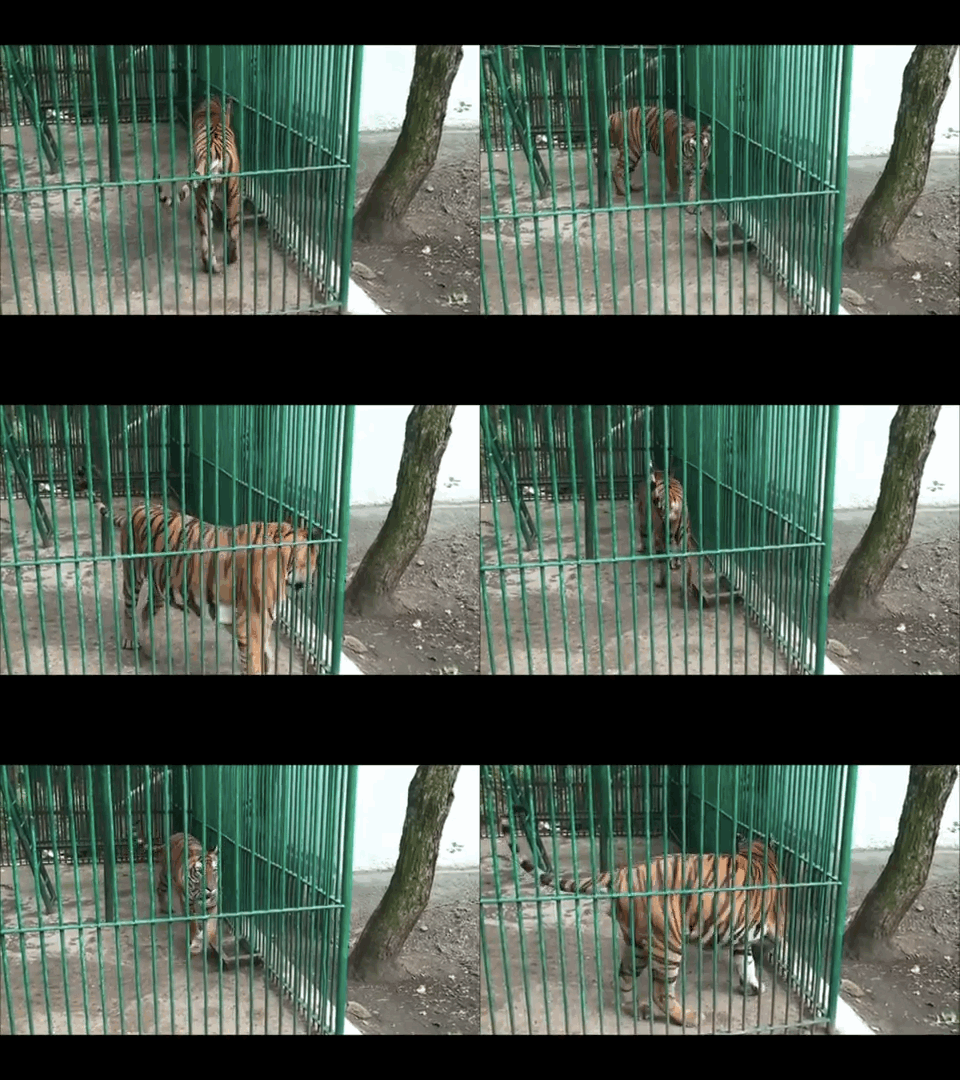
Animal Welfare-
Animal welfare is the well-being of animals. The standards of "good" animal welfare vary considerably between different contexts. These standards are under constant review and are debated, created and revised by animal welfare groups, legislators and academics worldwide. Animal welfare science uses various measures, such as longevity, disease, immunosuppression, behavior, physiology, andreproduction, although there is debate about which of these indicators provide the best information.
Concern for animal welfare is often based on the belief that non-human animals aresentient and that consideration should be given to their well-being or suffering, especially when they are under the care of humans. These concerns can include how animals are slaughtered for food, how they are used in scientific research, how they are kept (as pets, in zoos, farms, circuses, etc.), and how human activities affect the welfare and survival of wild species.
Animal welfare was a concern of some ancient civilizations but began to take a larger place in Western public policy in 19th-century Great Britain. In the 21st century, it is a significant focus of interest in science, ethics, and animal welfare organizations.
There are two forms of criticism of the concept of animal welfare, coming from diametrically opposite positions. One view, dating back centuries, asserts that animals are not consciously aware and hence are unable to experience poor (or good) welfare. This once-dominant argument is at odds with the predominant view of modern neuroscientists, who, notwithstandingphilosophical problems with the definition of consciousness even in humans, now generally hold that animals are conscious. However, some still maintain that consciousness is a philosophical question that may never be scientifically resolved. The other view is based on the animal rights position that animals should not be regarded as property and any use of animals by humans is unacceptable. Accordingly, some animal rights proponents argue that the perception of better animal welfare facilitates continued and increased exploitation of animals. Some authorities therefore treat animal welfare and animal rights as two opposing positions. Others see the increasing concern for animal welfare as incremental steps towards animal rights. The most widely held position in the western world is a mid-way utilitarian point-of-view; the position that it is morally acceptable for humans to use non-human animals, provided that adverse effects on animal welfare are minimized as much as possible.